
Irondequoit Resident Lookup Records
A careful resident lookup uses records that answer narrow questions. The Town assessment roll gives a dated owner, parcel, situs, and mailing-address lead. Monroe and New York voter tools answer a supplied identity-and-address question. Deed and court indexes place people in a transaction or case, while vital and probate indexes can help document a historical connection. None is a master list of town residents. The strongest match is agreement between independent records with compatible dates.
| Record | What it can establish | Irondequoit route | Access boundary |
|---|---|---|---|
| Assessment roll | Current roll owner, parcel, situs, and mailing clue | Town annual PDF | Public roll, not a household list |
| Voter response | Supplied person's registration or polling response | Monroe or New York lookup | Person-specific and regulated |
| Deed or court index | Transfer party, caption, filing, or case status | County Clerk, NYSCEF, or court clerk | Sealed and restricted files stay unavailable |
| Vital or probate index | Historical event or estate lead | RPL, NYS Archives, DOH, or Surrogate | Certificates and files have access rules |
| Business or license record | Public legal or professional role | New York DOS or NYSED | Role or service address is not residence |
Start with the record that matches what is known. A street and a parcel favor the roll. A court case number belongs in the court system. An older family question may fit a probate or directory search. Record the spelling, date, source, and result type before comparing it with another source.
Irondequoit Lookup Keys in the Roll
The 2026 final assessment roll is a large, searchable property index. Its entries can include tax-map number, property location, class, assessed value, exemptions, school district, current owner, current-owner address, parcel size, account number, and deed book/page. Search by the street and by the owner name, then try the parcel or SBL when a name is common. A parcel identifier such as 047.18-1-10 is often more stable than a name formatted with initials, a trust, or an entity.
Insider tip. Search the PDF by both street name and parcel/SBL. An owner-name search can miss a differently formatted name or an entity. Preserve the property location and owner mailing address as separate facts. The roll itself shows why: a mailing address can differ from the parcel situs.
That distinction keeps a resident lookup accurate. The owner field is a property relationship for the roll year. It does not identify every person at the parcel, prove an occupant, or create a continuous address history. A deed book/page can supply the next verification step through the County Clerk.
Note: Retain the roll year and parcel key so a later search can be checked against the same dated record.
Irondequoit Resident Lookup Voter Rules
The Monroe County voter lookup asks for street number, street name, ZIP Code, last name, and date of birth. It can return registration, polling-place, sample-ballot, or mail-ballot status for the supplied search. The statewide lookup similarly uses county, name, date of birth, and ZIP. Those responses can help verify a specific identity-and-address combination, but neither tool is a browsable roster for an entire street.
The voter record is public only within New York's limits. Election Law §§3-103 and 3-220 regulate voter-data access and use. Identification numbers, Social Security information, and facsimile signatures are excluded from public disclosure, and protected records remain protected. Do not turn a person-specific response into a list of nearby people or use it to infer a historical address.
See the county voter lookup before entering a search. The screen shown below uses address, name, and date fields rather than a block-browse control.
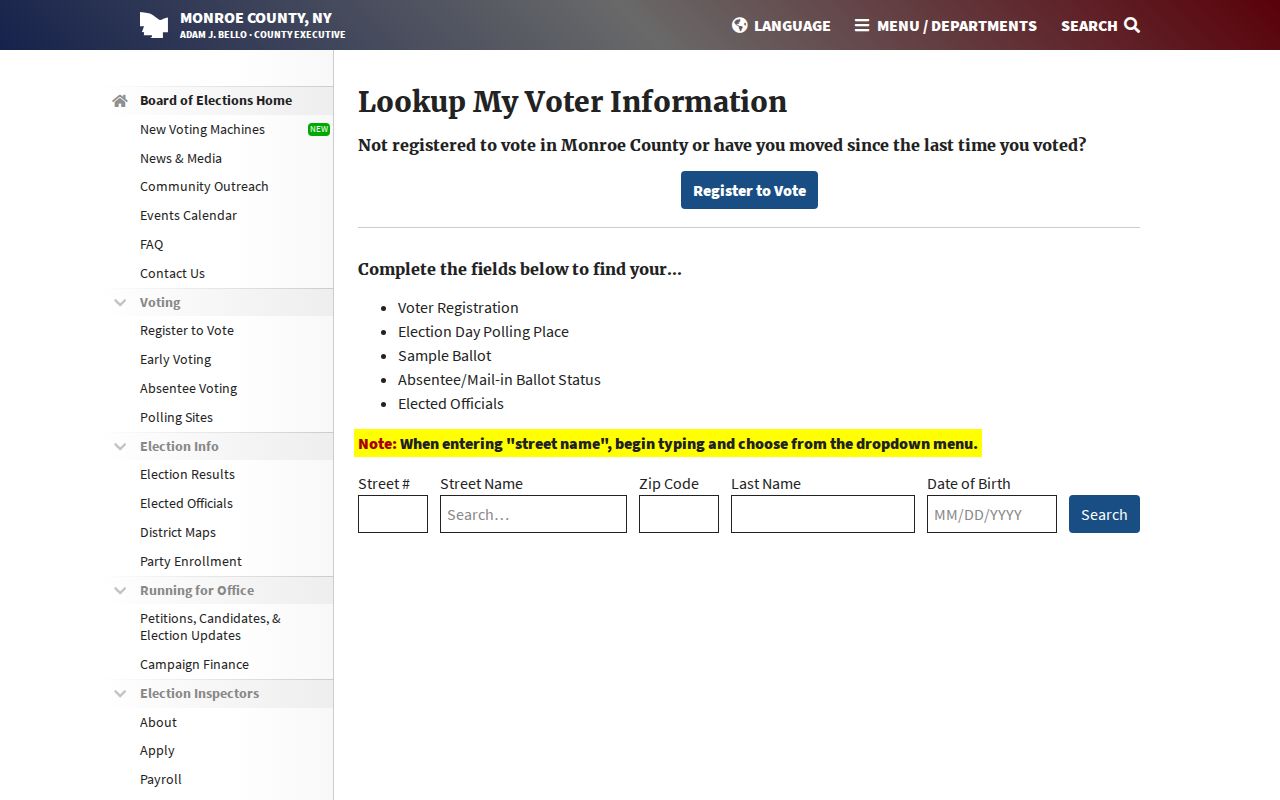
Use a voter response as one dated confirmation beside a roll, deed, or court record, not as proof of every household member.
Verifying an Irondequoit Resident Match
A name needs context before it becomes a reliable match. Compare the middle initial, spouse notation in an older directory, age or birth-year clue where lawfully available, street spelling, parcel, postal city, and record date. Irondequoit addresses may use Rochester as the postal city, and a current parcel record may list a different owner mailing address. Two sources that agree on name and a compatible date are stronger than a surname alone.
- Anchor the name to a dated parcel or address through the assessment roll, keeping the situs and mailing fields separate.
- Check the County Clerk index for the deed book/page or use the party name to find a transfer lead.
- Search the appropriate court or probate index with the fuller name, county, and date filters, then compare the case details.
- Use a vital index, obituary, directory, or official certificate route only when it fits the historical question and access rules.
- Docket
- A court's running file record for a case, showing its identifier and filed events.
- Index and image
- An index is the searchable entry. An image is the underlying document, which may have a fee or access limit.
- Certified copy
- A copy issued or authenticated by the custodian for an official purpose; it is different from an index result.
Do not solve a mismatch by blending details from several namesakes. Keep competing records separate until a parcel, date, relationship, or case identifier supports the connection. A negative result is also useful when the source, spelling, and date range are recorded.
Irondequoit Court and Probate Lookup
NYSCEF Case Search permits a guest search by case identifier, party or attorney name, Tax Cert/SCAR block and lot, or new cases. Name searches can be narrowed by county, case type, and filing date. WebCivil Local covers participating local civil courts. For a town-court matter, contact the Irondequoit Town Court clerk because no complete public town docket was located. Online court results vary by system and do not include every file.
For estate research, the Monroe Surrogate's Court public records index provides decedent and proceeding paths for 2012 through 2026 plus older indexes. A probate file can be an heir or estate lead, not proof of a current Irondequoit address. Note the decedent name, proceeding number, index year, and source page before asking about an available copy.
A useful case-result inventory includes:
- short and full caption;
- case type, status, and index or docket number;
- filing events and dates;
- party names and representation; and
- public document availability or a restriction notice.
Sealed matters, protected proceedings, cases not yet entered, and court-specific gaps can keep a valid record out of an online result. A no-result search should be recorded as a limited search, not treated as proof that no record exists.
Irondequoit Resident Lookup Vital Routes
Vital records are best used for an event or family-history question, not for a broad resident lookup. Monroe County Vital Records is the local route for eligible birth and death copies. The New York State Archives describes historic index access: births generally open after 75 years, while marriages and deaths generally open after 50 years, subject to the stated deceased and direct-line rules. The index is a lead, not a certificate.
The New York State Department of Health handles statewide records outside New York City and divorce certificates since 1963, while a divorce decree comes from the court or County Clerk. Monroe lists mail routes and forms alongside its local service. For a marriage-license question, the filing office is where the couple applied, which may not be where a ceremony occurred.
A birth-parent question belongs with the New York Adoption Information Registry and its controlled process. For an old local notice, Rochester Public Library's Local History & Genealogy Division holds indexes, directories, and microfilm with access conditions that differ by collection.
Note: Avoid publishing modern certificate images or sensitive details that are not required to document an historical research finding.
Irondequoit Owners Are Not Residents
Myth: a property owner named in a tax roll must be the person who lives there. The assessment roll identifies the current roll owner and may show a mailing address, not every person at the property. An entity can own a parcel, several names can appear, and the mailing location can be elsewhere. The roll's owner, mailing, and situs fields must not be merged into a claim about occupancy.
For a dated historical household, a 1930 to 1940 suburban directory entry can be more direct about a person associated with an address. It still needs its own limits: directories omit some people, carry compiler errors, and reflect the date of that edition. Pair a historical directory clue with a deed, census, obituary, map, or court record that supports the specific relationship being researched.
FOIL for an Irondequoit Record Gap
When an online index ends, ask the agency that created the record for a narrow, existing record. Irondequoit's FOIL route is governed by New York Freedom of Information Law, Public Officers Law Article 6, §§87 to 89. Describe the record type, address or parcel where relevant, approximate date range, and whether an electronic copy is acceptable. A focused request is easier to locate and review than a request for a general resident list.
The Town generally targets an acknowledgement, denial, or availability response within five business days, while privacy and safety exemptions still apply. A request can reach permits, code files, planning packets, or other existing town records where the research question is tied to a date and address. It cannot require the town to create a new database or disclose protected personal information.
The Town's FOIL request page is the source for the request route shown here.
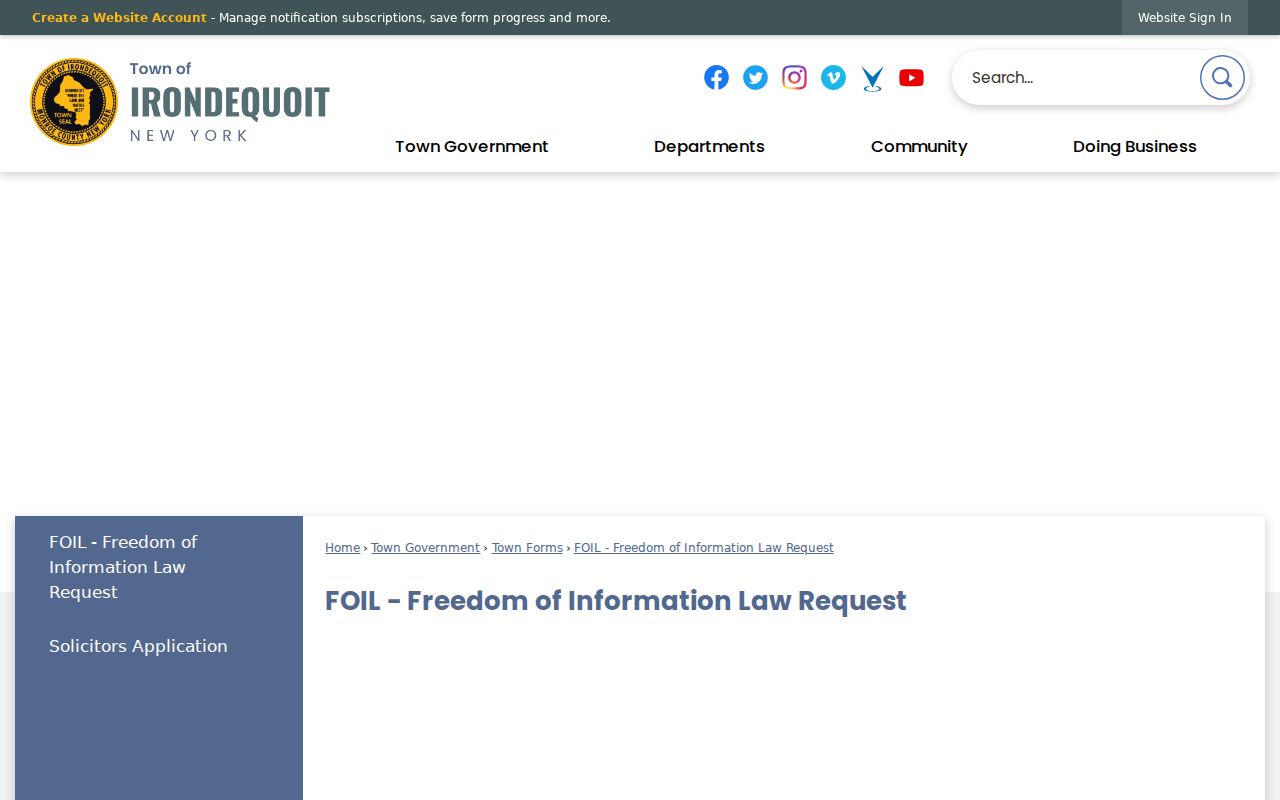
Keep a copy of the request wording, acknowledgement, response date, and any stated exemption with the resident lookup notes.
Irondequoit Resident Lookup Privacy
New York FOIL presumes access to agency records, but it also permits withholding for privacy, safety, law-enforcement, and other protected interests. The Address Confidentiality Program can provide eligible people with a substitute mailing address, and agencies must accept it. Protected voter records, personal contact details, children’s information, Social Security numbers, signatures, DMV information, and confidential victim data are not material to combine or republish.
Use official custodians for corrections. A records index may contain a stale or incomplete entry, and a commercial data service can add another unverified layer. A resident lookup remains most useful when it reports exactly what a dated source says and does not turn a lead into a claim of current residence.
Lawful use. Use Irondequoit records for personal, lawful research and do not use information from a resident lookup to stalk, harass, intimidate, or harm anyone.
Note: Keep an ACP or protected-voter location separate from other records and never try to reconstruct it by joining sources.