
Irondequoit City Directory Holdings
Irondequoit is best researched through Rochester Public Library's regional shelves and digital collection. The main Rochester run begins with original bound volumes in 1827 and survives through 1946 with gaps. Its suburban companion gives Irondequoit an alphabetical section in annual volumes from 1930 through 1940. Those volumes are more direct than trying to force an Irondequoit name into a Rochester-only address. The 1930 edition identifies Sampson & Murdock Co. of Rochester on its title material; later editions should be cited by their own title pages rather than assigned that publisher by default.
| Collection | Years | Publisher or format | Where held | Access |
|---|---|---|---|---|
| Rochester City Directories | 1827-1946 existing volumes, with gaps | Edition-specific city volumes | Rochester Public Library | Digitized and on-site collection access |
| Rochester House Directory | 1892-1920 | Fifteen-volume street-address series | Rochester Public Library | Use the house directory for an address lead |
| House sections in main directories | Generally from 1922 | Street and house section at volume back | Rochester Public Library | Check the specific edition |
| Rochester Suburban Directories | 1930-1940 | 1930 credited to Sampson & Murdock Co. | RPL digital collection | Annual PDFs with an Irondequoit section |
The Rochester City Directories collection supplies the digitized route, but a missing year may simply be a gap in surviving volumes. Directory inclusion is not proof of continuous residence, and the compilers could miss names, children, people without a fixed address, advertisements, or a changed boundary.
The digitized Rochester volumes are supplied through the Gleason Foundation. Open the title material before copying a citation because the publisher details can differ by edition. The suburban series has a fixed internal order of introduction, Brighton, Gates, Greece, Irondequoit, business directory, and end. Go directly to the Irondequoit section after recording the volume year, then keep the printed page and the PDF location together in the research notes.
Irondequoit Directory Years at RPL
The Rochester Public Library Local History & Genealogy Division is in the Rundel Memorial Library at 115 South Avenue in Rochester. Its collections do not circulate. Walk-ins are accepted, but an appointment is recommended for special collections, and construction has moved some microfilm offsite. That makes a short call or message worthwhile before a trip for a particular directory, map, yearbook, or newspaper reel.
RPL combines the directory shelves with local-history digital collections, maps, photographs, manuscripts, school yearbooks, a local vital index, newspaper tools, and in-library resources. Some databases need a Monroe County Library System card, an on-site computer, or remote authentication. A city directory search benefits from recording the exact volume and page first, then asking library staff whether a companion map, newspaper index, or yearbook can test the same name and place.
Access routes vary by item. Recent newspapers, the 1950 Census, local digital collections, and some database results can be reached remotely or through a library account. Fire-insurance maps and some special collections require an in-library computer or a visit. Herald and Post-Express microfilm is currently offsite, and digitization is unavailable for that material. These limits make an exact year, street, and surname much more useful in a request than a broad question about everyone connected to Irondequoit.
Note: PDF page numbers can differ from the printed pages, so preserve both when citing an Irondequoit directory finding.
Decoding Irondequoit City Directory Entries
The 1930 Irondequoit volume opens with a key rather than leaving its shorthand unexplained. It uses res for residence, rd for road, r for rural, tel for telephone, wid for widow, wkr for worker, supt for superintendent, and R D for rural delivery. A parenthetical postal label follows the street address. The volume specifically warns readers not to use Irondequoit as a mailing address, which is why a listing may say Rochester or a rural route even for an Irondequoit street.
| Name form | Copy initials, honorifics, and spelling as printed before normalizing a name. |
|---|---|
| Spouse notation | Parentheses can identify a spouse and help distinguish people with the same surname. |
| Historical activity clue | A trade, title, company abbreviation, or other contemporaneous label can separate namesakes. |
| Street wording | house or res plus a number and road ties the entry to a dated address. |
| Postal parenthetical | (Roch) or (R D 7 Roch) records how mail was routed, not a separate town residence. |
- Criss-cross directory
- An address-first arrangement used to turn a street and house number into a historical person-place lead.
- Householder index
- A street or house list that points from an address toward a listed household name in a particular edition.
- Abbreviation key
- The opening legend that gives a volume's shorthand its proper meaning and should be saved with the entry notes.
Irondequoit Directory Address Sections
Address-first research is available in the Rochester House Directory for 1892 through 1920 and, generally, in the house section placed at the back of main directories from 1922. The 1930-1940 suburban volumes also contain alphabetical name and street lists. These arrangements are helpful when a family has an old street name but no surname, or when a property history needs a dated person-place lead.
Use the entry as a lead, then compare its street spelling, house number, postal parenthetical, and year with maps and deeds. A directory can omit people or reflect shifting boundaries. When the question is about a present parcel or a full modern street sequence, the Irondequoit by-street directory uses current address-keyed public records instead of rebuilding the historic shelf.
Irondequoit Directory Research Help
For a local name, building, or neighborhood reference, the Irondequoit Historical Society offers publications, historic-document cataloging support, Pioneer House interpretation, and monthly meetings at the Irondequoit Public Library. The Town Historian can help place an older name or building in context. Neither source is a public list of people, but each can help determine which primary collection deserves the next search.
The library's Life Records index is also useful when a directory trail ends. Early Rochester newspaper material begins in 1818; the index reaches 1818-1903, with online coverage through 1897. A brief notice, spelling variant, or index limit can produce a missed result, so keep the exact search terms. RPL's reference help is limited, and written or email requests for articles are limited to five and are not rush service.
Note: Contact RPL before traveling because offsite microfilm and appointment needs can change access to a specific Irondequoit directory source.
Irondequoit City Directories and Census
Follow a household through several editions rather than treating one listing as a full biography. The strongest sequence starts with the exact surname and given-name spelling in the Irondequoit section, then retains the page, year, street, spouse notation, activity clue, and postal parenthetical. A changed initial, road, or postal city may help separate similar names. It may also signal a move, a compiler variation, or a different person.
- Find the first dated Irondequoit listing and copy its details exactly.
- Check one or two editions before and after it for a new street, spouse notation, or changed postal route.
- Use the reverse street or house section when available to find other listed people at that address in that edition.
- Pair the directory year with a federal census that is public under the 72-year rule, rather than assuming either series is continuous.
- Use a newspaper notice, cemetery record, probate source, or map to test why the household trail changes or stops.
Federal schedules provide dated household context, and the 1950 Census is public. RPL also offers access to the 1950 Census and several genealogy resources. Record negative results, too. A missing child, a name variation, a boundary change, or a compiler error is different from proof that a family was absent.
Irondequoit Directory Record History
Irondequoit formed from Brighton in 1839, while Monroe County began in 1821 from Ontario and Genesee County territory. That sequence matters when a property trail predates the town or uses an older jurisdiction. Nineteenth-century descriptions may identify a farm, lot, creek, or road rather than a present house number. Later directories add street, household, and postal clues, while modern parcel records use tax-map and geometry fields.
| 1821 | Monroe County begins, making predecessor-county research important for earlier instruments. |
|---|---|
| 1827 | The surviving Rochester City Directories run begins at RPL. |
| 1839 | Irondequoit forms from Brighton. |
| 1930-1940 | The suburban directory series gives Irondequoit its own annual alphabetical section. |
| Modern era | Assessment rolls, parcel geometry, and indexed deed images use different keys and dates. |
Those changing record formats are a reason to pair an Irondequoit city directory entry with the source closest to its date. A rural-route label, a later parcel map, and a modern postal city can all describe the same place at different points in time without being interchangeable.
Irondequoit Directory Landmark Leads
A property appearing in the Town's landmark material can be a useful prompt for deeper address research. The Historic Preservation Commission's landmark and survey record identifies resources including Town Hall, Pioneer House, Hooker Cemetery, cobblestone structures, churches, and historic residences along local roads. Its 2025 reconnaissance survey reaches from the 1600s through the 1970s and identifies potential districts and more than 100 individually eligible properties, but it is not exhaustive.
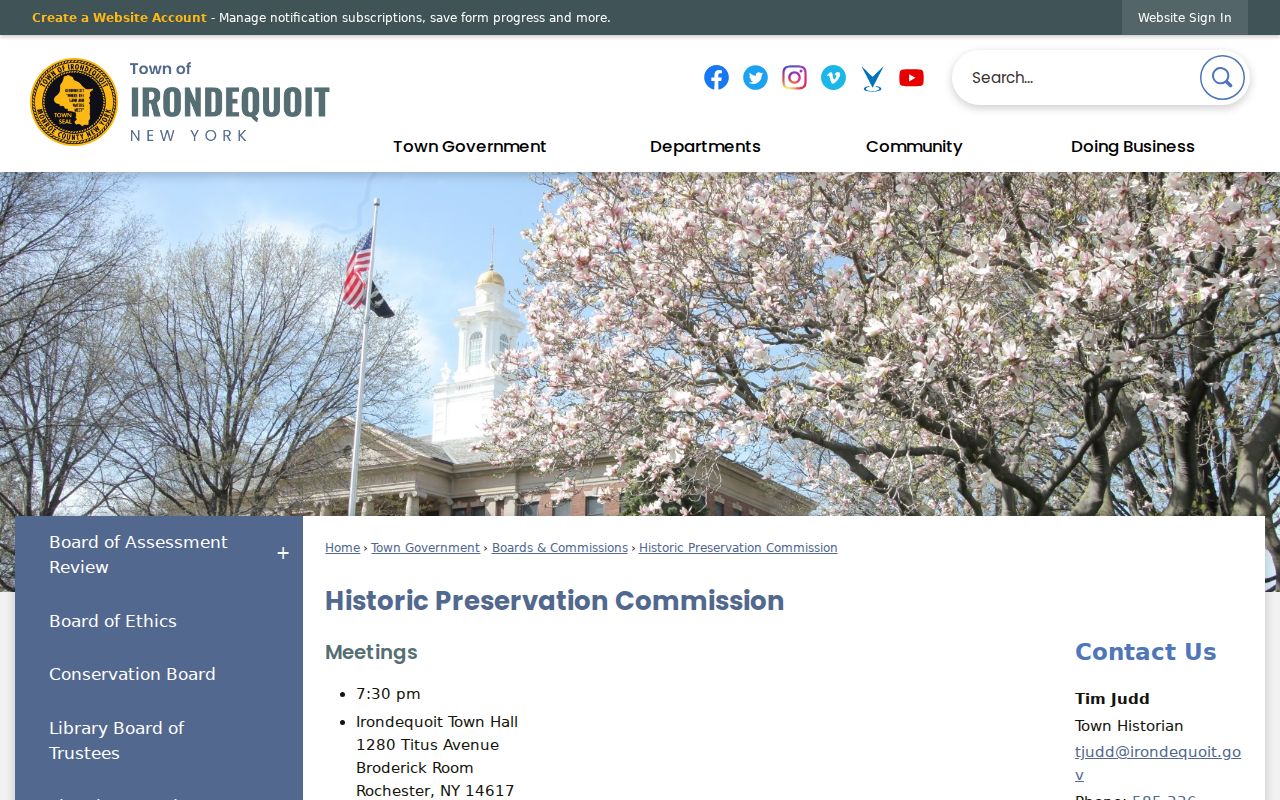
Use a landmark or survey entry to choose a map, deed, directory year, or photograph to check next. It does not establish who lived at a property in any particular year. The underlying city directory volume, deed, map, or archival record remains the source for a person-place claim.
Irondequoit's record geography also explains why a search can surface Rochester, Monroe County, and town labels together. The town lies between Lake Ontario, Irondequoit Bay, and the Genesee River, and roads such as Culver, Titus, East Ridge, St. Paul, and Ridge Road recur in directories, parcels, landmarks, and neighborhood references. Keep each label with the source that used it. A Rochester postal parenthetical may be the right historic detail even though a later parcel record is governed by the Town of Irondequoit.