
Start an Irondequoit Residents Directory Search
Use the record that matches what is already known. An address works best with the Town assessment roll and the Monroe County parcel viewer. A full name can lead to a voter-status search, a court index, a deed party index, or a dated directory. An old street and a year belong at Rochester Public Library. Each record answers a narrower question than “who lives here,” so keep the source date and the relationship it proves.
The town roll identifies a taxed parcel and its listed owner, not every person at the address. A deed tracks a legal transfer. A historic directory places a person or household at a printed address on its publication date. Checking two independent records is the safest way to separate a useful lead from a same-name match.
- Search the annual assessment roll by owner, street address, or parcel ID.
- Map the result in the County parcel viewer and preserve the parcel identifier.
- Use the Clerk index for a dated deed-party trail, then request the image by the available route.
- For a past household, compare the suburban directory, newspapers, and census-era sources at the library.
- Ask the actual custodian for a defined existing record when no public index answers the question.
Irondequoit Residents Directory Record Offices
Irondequoit uses town channels for assessment, taxes, building matters, local minutes, and records requests. Monroe County keeps the land-record index, county parcel tools, elections resources, and several court routes. The office name matters because a parcel, an election-status result, and a court filing have different custodians and different limits. For a street-by-street parcel method, use the Irondequoit by-street directory.
Town of Irondequoit Assessor
1280 Titus Avenue
Rochester, NY 14617
585-336-6055
Irondequoit Assessment Roll Records
The Town assessment-roll page publishes tentative and final annual rolls and directs users to search a downloaded PDF by last name, street address, or Parcel ID. The 2026 final roll has 5,333 pages. It holds the information needed to anchor an address search: parcel or SBL number, class, assessment, exemption, school district, listed owner, and mailing field. Treat it as a dated tax record, not a household roster.
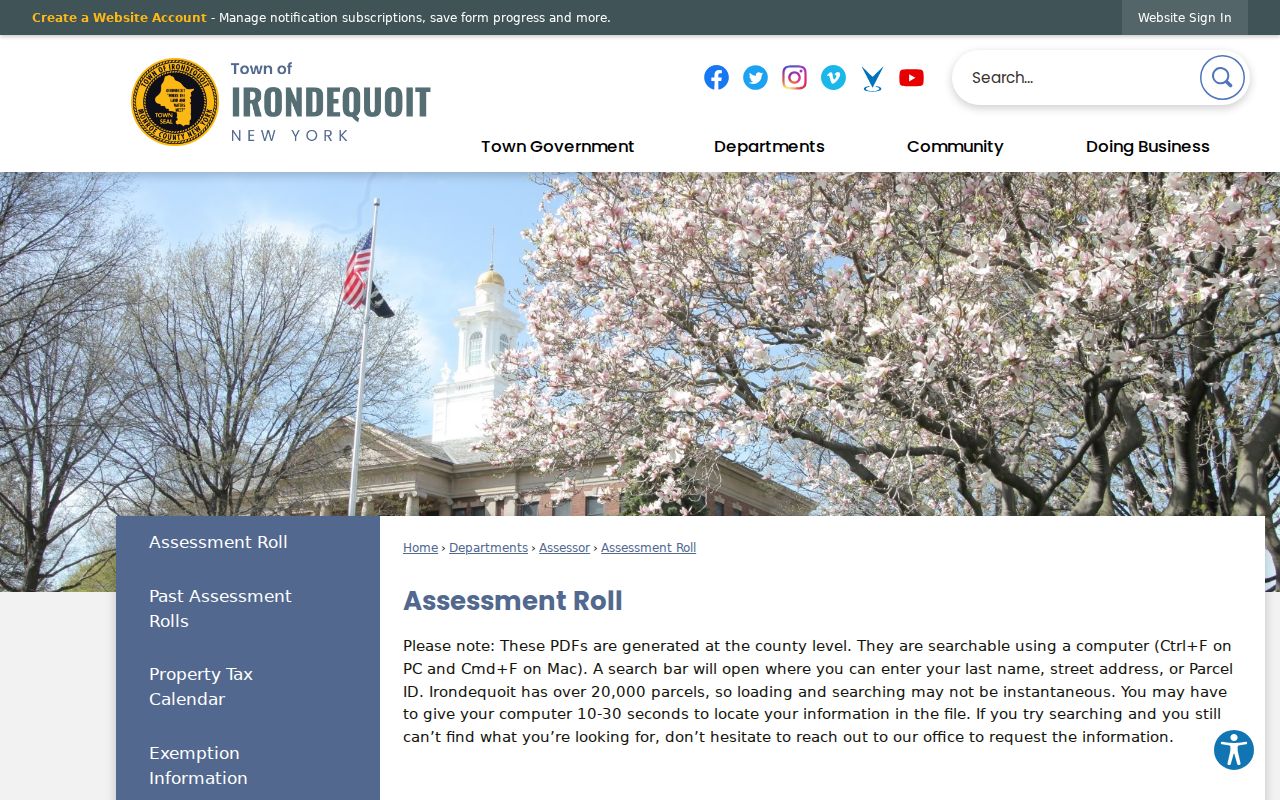
The assessment-roll screen points to the year-specific files. Downloading the appropriate edition first makes street, owner, and parcel searches more reliable than repeatedly scrolling a long browser document.
| Assessment-roll field | Use in an Irondequoit search | Limit |
|---|---|---|
| Owner | Starting lead for a deed or tax record | Owner is not necessarily an occupant |
| Situs and mailing address | Separates parcel location from contact routing | They can differ |
| Parcel or SBL | Stable key for GIS and tax records | It identifies property, not a person |
| Book/page lead | Helps retrieve a related Clerk instrument | Confirm the deed in the index |
Note: Keep the roll year beside every result because ownership, exemptions, and mailing details can change from one annual edition to the next.
Irondequoit Voter Lookup Limits
The Monroe County voter lookup is for a supplied identity and address, not broad browsing. Its visible inputs include street number, street name, ZIP, last name, and date of birth. The state lookup provides another official route. A returned status or polling result can help confirm a carefully defined person record, but it should not be converted into a general list of people on a block.
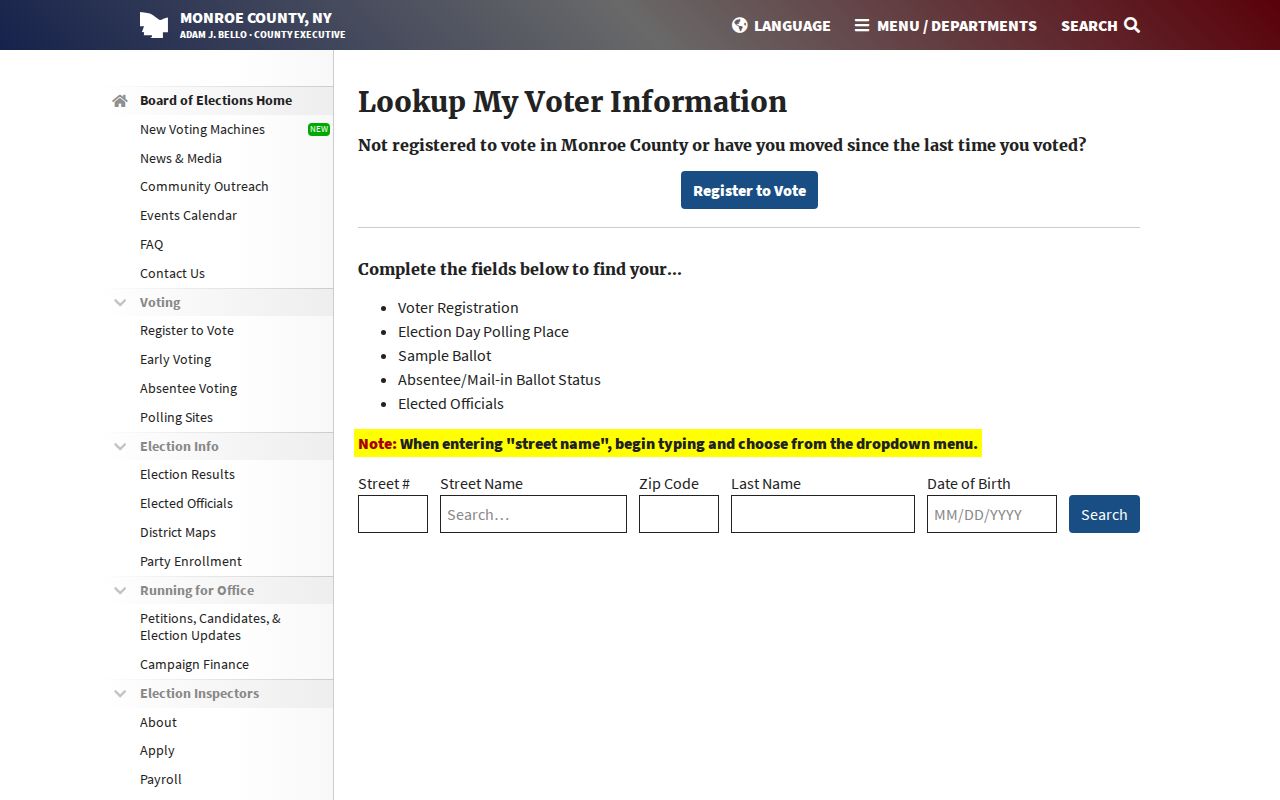
The captured form shows why exact identity details matter. New York Election Law sections 3-103 and 3-220 restrict voter-file use and exclude sensitive fields such as identification numbers, signatures, and protected records.
Irondequoit FOIL Records Route
When a town record has no searchable index, begin with the Irondequoit FOIL instructions. Ask for an existing record by type, street or parcel, department, and date range. The town accepts requests through its form, in person, or by mail to the Town Clerk at 1280 Titus Avenue. It describes a five-business-day window for an acknowledgement, availability notice, denial, or time-and-cost estimate.
The request screen is a starting point, not an invitation to ask the town to create a new directory. Privacy, law-enforcement, judicial, confidential-source, trade-secret, and internal-material exemptions can narrow what is released. Letter and legal-size paper copies are listed at $0.25 after the first four pages.
Electronic fulfillment is preferred when the record can be sent in that form. Records that are too large or exist as photographs, video, or other special formats may require a different delivery method and a cost estimate. Save the request description and the agency response with the research notes. That paper trail makes a later follow-up more precise and keeps a missing record from being mistaken for proof that no record exists.
Current Irondequoit Residents Directory Sources
A current Irondequoit residents directory is assembled from limited official records, not found in one master file. The assessment roll is strongest for a dated owner-to-parcel connection. The Clerk index identifies parties to land documents. The voter lookup verifies a supplied registration question. Town minutes, planning files, and public-facing license or entity records can identify a role connected to a place, but none of them proves that every member of a household is present.
| Source | Who It Lists | Keeper | Access |
|---|---|---|---|
| Annual assessment roll | Listed parcel owners and tax fields | Town Assessor | Annual PDF and office |
| Voter lookup | Status and polling information for supplied details | Monroe elections | Official lookup, regulated use |
| Clerk land-record index | Parties to deeds, liens, and mortgages | Monroe County Clerk | Guest index and public terminals |
| Town agendas and minutes | Applicants, petitioners, or property matters | Town departments | Archive, counter, or FOIL |
| Neighborhood finder | Association-area context | Irondequoit Neighborhoods | Address map, not a resident list |
Choose the source by relationship and date. A name that appears in a land instrument may be a buyer, seller, lender, or other party. A person-specific question needs a narrower resident lookup method, where court, vital, and historic trails are kept separate.
Local access also has useful fallbacks. The Clerk supplies public terminals when an online guest index lacks an image. The Town Clerk can receive a focused FOIL request when a defined municipal record is not posted. RPL provides in-library databases, microfilm, maps, and reference help when a digital directory run stops. A phone call or counter visit may be the right next step, especially for historical material, but it should request a named record rather than a broad list of people.
Irondequoit Deed Records in 2026
The Monroe County Clerk records page provides several access channels: online database, public terminals, phone or fax search assistance, and historical indexes or microfilm. Online land-record coverage begins in February 1984. Older chains may need the historical grantor and grantee indexes. The Clerk’s chain reaches to 1821, while still earlier material may appear under Ontario or Genesee County.
The County’s April 2026 change separates a free guest index from online image access that requires a subscription. Public Clerk terminals still offer full index and image access without that subscription. A dated original, legal description, party names, and book/page data turn an index result into a record-retrieval request. A $0.65-per-page copying charge and $1.30 minimum are listed by the Clerk, with certification charged separately.
The Clerk’s order form shows the details that make a request usable: requester contact information, the document category, the party names, recording date, liber or book and page, instrument number, municipality, and copy or certification choice. A search fee is listed at $5 for each two-year period. Give the Clerk the known book/page or instrument number when possible, and ask for a search only after narrowing the likely date. Confirm all fees with the office before payment because a research lead, plain copy, and certified copy are different requests.
The County Clerk access page shows the official route for land records and public terminals.
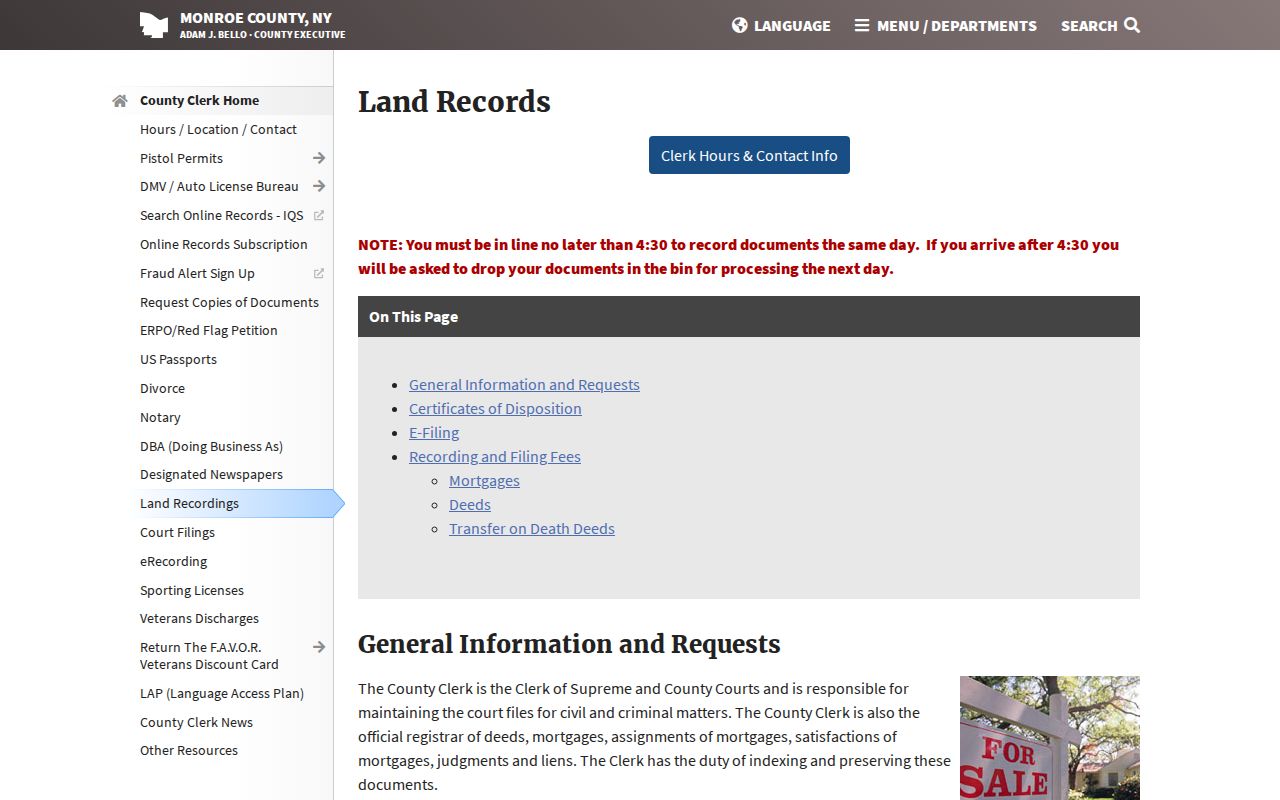
The screen makes the split between online access and in-person record work visible. A free party-name hit does not mean that an image, certified copy, or full historical chain is available without another step.
| Access route | What it supplies | Practical limit |
|---|---|---|
| Guest online index | Party names and property address | Images are not included |
| Online subscription | Viewing, downloading, and printing images | Regular copy charge still applies |
| Public Clerk terminal | Full index and image access | Requires an in-person visit |
Irondequoit Parcel Record Terms
Records use a few words in precise ways. Reading them correctly avoids a common error: treating a mail contact, tax owner, or document party as proof of present residence. Preserve the original field label and record date when copying a result into notes.
- Assessment roll
- An annual tax list that ties parcel fields, value, exemptions, and a listed owner to a roll year.
- Parcel or SBL
- A property identifier used to connect the assessment roll, GIS, tax, and deed research.
- Index
- A searchable reference to a filing. It may provide names, dates, and book/page data without the record image.
- Criss-cross directory
- A historical directory arranged by address, used to locate a printed occupant lead for a particular year.
For a single address, keep the situs, mailing address, postal city, ZIP, and parcel key in separate columns. The 2026 roll can show a property location and an owner mailing address that are not the same place.
Irondequoit Postal Record Names
Irondequoit is a town, yet many addresses use Rochester as the postal city. The 1930 suburban directory specifically instructed users not to use “Irondequoit” as a mailing address and printed the postal city in parentheses. That is a local search clue, not a boundary change. Compare the exact address with USPS ZIP Lookup and the County map before assuming that a postal label identifies the municipality.
County GIS lists 14609, 14617, 14621, and 14622 in the Irondequoit-area ZIP geography. A ZIP is a mail-routing tool. It does not establish occupancy or an association boundary. Keep postal, parcel, and neighborhood questions separate when comparing a result.
Irondequoit Privacy and Record Boundaries
New York’s Address Confidentiality Program can substitute a designated address for eligible participants. Protected voter records, vital-record access periods, sealed court files, DMV limits, and FOIL exemptions also narrow a public trail. A missing result may reflect privacy protection, a date limit, a spelling difference, or a system that has not digitized that record.
For state-agency personal information, Public Officers Law Article 6-A provides access and correction rights. The right response to a questionable result is to contact the agency that holds it, preserve the source date, and avoid reposting sensitive details. A search result should support a narrow, lawful purpose such as family history, estate work, civic research, or fraud prevention.
Vital records have their own access clock. New York Archives guidance describes historical index access for births after 75 years and marriages or deaths after 50 years, subject to deceased-person and relationship rules. The archive explains that an index is not the underlying certificate. For an event in Monroe County, the County Vital Records office, the State Department of Health, and RPL’s local indexes serve different access roles. Keep the event place, date, and eligibility rule beside the result.
Note: A public index can be incomplete or redacted, so verify important details with the named custodian before relying on a record.
Historical Irondequoit Residents Directory Shelf
Rochester Public Library’s Local History & Genealogy Division is the regional stop for old resident directories, newspapers, maps, vital indexes, and microfilm. The digitized Rochester city-directory collection begins in 1827. The suburban run includes dedicated Irondequoit sections from 1930 through 1940, with the 1930 volume credited to Sampson & Murdock. A printed entry can supply a name, spouse notation, occupation, street, and postal routing for that year.
Collections are non-circulating. Walk-ins are accepted, but special collections may need an appointment and some microfilm is offsite during construction. RPL is at 115 South Avenue, Rochester, NY 14604, phone 585-428-8370. The Irondequoit city directories collection explains how to read entries, reverse sections, and the historical gaps without treating one volume as a continuous record.
RPL’s resource list includes the 1950 Census, in-library Ancestry Library Edition, HeritageQuest, fire-insurance maps, local-history digital collections, NY Heritage, newspapers, yearbooks, and the Rochester Newspaper Index. Some resources require a Monroe County Library System card, a library computer, or remote authentication. Its Life Records index covers notices from about 1960 to 2016, while the earlier newspaper index begins in 1818 and has online coverage through 1897. A short notice or spelling variation can explain a missed hit.
Irondequoit Survey Record Leads
The Historic Preservation Commission reports that its 2025 reconnaissance survey is the town’s first of its kind. It spans resources from the 1600s through the 1970s and identifies potential historic districts and more than 100 individually eligible properties. It is useful for choosing a house-history lead, not for naming a past occupant.
Irondequoit was formed from Brighton in 1839, and Monroe County’s land-record history begins in 1821. An early document may therefore use a predecessor jurisdiction, a farm description, a lot, or a road label rather than a modern house number. Pair the survey with a parcel, plat, directory, or Clerk record to build a dated connection. The County’s ongoing index-book digitization effort may improve future access, but the current coverage must be checked before planning a search.
A careful local-history note records both what was found and what was not found. Start with the survey address or resource name, then identify the tax parcel and check whether the Clerk’s index carries a related deed. Use the directory year as a dated household clue, not a conclusion. If an older map and a current parcel do not line up, ask the library or Town Historian about road names, subdivisions, and boundary changes before joining the records. That extra check protects against a persuasive but incorrect person-place match.
For a record that predates the town, note the jurisdiction printed on the original instead of silently changing it to Irondequoit. Land that is now inside the town may be described in a predecessor county or as part of Brighton. The source label belongs in the citation because it explains where a researcher should look next. That practice also makes it possible for a reader to repeat the search if an online index changes or a digitized collection expands.
The Town Historian can help identify older road labels and local place names.